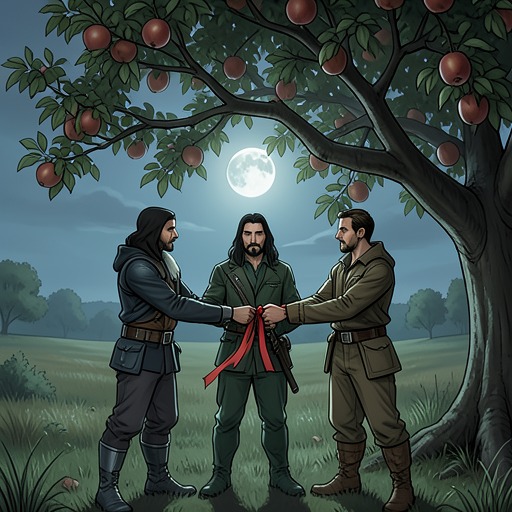
Xuande–Zhang Fei sworn brotherhood
The Romance of the Three KingdomsThe Xuande–Zhang Fei sworn brotherhood is the personal bond at the heart of the alliance among Xuande, Zhang Fei, and Guan Yu. Formed in Zhang Fei’s flowering peach orchard through offerings and a vow before Heaven and Earth, it gives their shared military undertaking a familial order and an enduring standard: even after the loss of Xuzhou and Xuande’s family, Xuande invokes the oath to prevent Zhang Fei from abandoning their common path.
Formation in the Peach Orchard
Zhang Fei proposes that the three men go to the orchard behind his manor, then in full flower, to make sacrifices to Heaven and Earth and bind themselves to fulfil their destiny together. Xuande and Guan Yu readily agree. The setting and ritual make their partnership more than a convenient arrangement for answering the call to arms: their undertaking is publicly and solemnly framed as a commitment to stand by one another through the adventure ahead.
The three prepare offerings that include a black bull and a white horse. Amid the incense smoke, Xuande, Guan Yu, and Zhang Fei make their vow. Its defining promise is that men from separate families will stand together; its seriousness is underlined by the oath’s appeal to Heaven and the people should they fail to act with grace. Their brotherhood is thus grounded both in mutual loyalty and in a moral obligation that reaches beyond the three participants.
After the vow, they establish a precise family-like order: Xuande is the elder brother, Guan Yu the second, and Zhang Fei the third. They cook the sacrificial meat, share wine, and invite roughly three hundred local recruits to feast with them in the orchard. The gathering connects the intimate oath to the larger force they are assembling. In the following days, the group gathers weapons, horses, and armour; Xuande has two double-edged swords made, Guan Yu a curved sword, and Zhang Fei a long spear. Their pledge quickly becomes the foundation for a practical military undertaking.
The Oath Put to the Test
The brotherhood is tested when Xuande loses Xuzhou and his family. Zhang Fei is on the verge of taking his own life, treating the disaster as a failure from which he cannot recover. Xuande stops him by taking away the sword and recalling the brothers’ peach-orchard oath: they had promised to seek death together, but that promise is not a reason to die separately over one defeat. Xuande instead argues that the three must continue along the path they chose together.
Xuande also puts the immediate loss in perspective. The city, he says, had never truly been his, and he believes Lü Bu will not harm his family but protect them. His response does not deny Zhang Fei’s distress; it counters despair with trust in their continuing bond and with the possibility that the family is safe. Xuande’s words turn the original vow from a declaration made at the beginning of their adventure into a resource for surviving its reversals.
The appeal reaches beyond Zhang Fei alone. As Xuande weeps, Guan Yu and Zhang Fei weep with him. The scene presents grief as shared among the three, while the choice before them is whether a lost city and endangered household will dissolve their fellowship. Xuande’s intervention keeps the bond intact: the oath is not fulfilled by a dramatic end, but by continuing together despite defeat.
Brotherhood in a Divided World
The novel places this personal pledge within a history of civil conflict and political collapse. Its account uses historical events as a foundation but reshapes them through epic storytelling, folk performance, and a novelist’s synthesis. In that form, the peach-orchard oath offers a memorable human bond against a wider world of competing powers, betrayal, and repeated military reversals.
The brotherhood’s force lies in how it combines affection, hierarchy, and shared purpose. Xuande is named eldest, yet his authority in the crisis is expressed not through command alone but through an appeal to what all three freely promised. The oath therefore works both as a relationship and as a continuing principle of action: a lost city can change their circumstances, but Xuande insists it cannot by itself cancel the path they chose together.
The bond also carries the story beyond its founding scene. The novel’s use of poems and theatrical traditions helps explain how a compact episode can serve as a lasting summary of character and commitment. Here, the orchard ritual supplies the terms by which later adversity can be understood: the brothers’ alliance is not measured only by success in battle or possession of territory, but by whether they remain bound to one another when those advantages disappear.